
Countdown to 2nd World Summit for Social Development: Why We Must Care
A reflection on the discussions held at the GETSPA webinar titled, “Advancing transformative social policy in Africa - towards an agenda for the second world summit for social development”
By Audrey Gyamfi
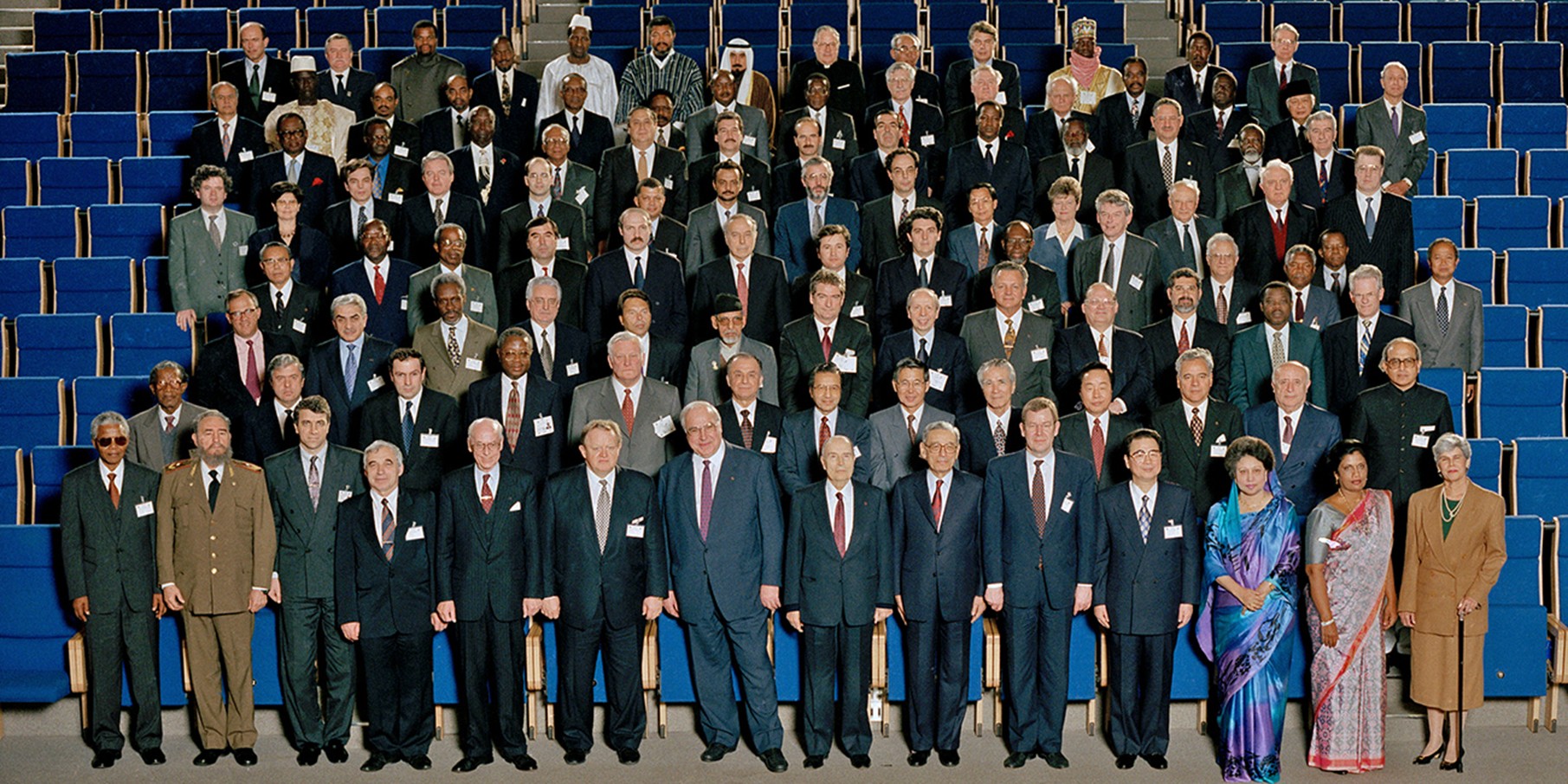
Global leaders at the first World Summit for Social Development in Copenhagen, 1995
Image credit: United Nations. Conferences | Social Development
It’s been 30 years since the famous congregation of world leaders in Copenhagen, Denmark for the first World Summit for Social Development. This gathering produced the Copenhagen Declaration and Programme of Action—a 150-page blueprint for tackling poverty, unemployment and social exclusion. In a very significant move, the summit attempted to address issues such as inequality and underdevelopment by identifying their structural drivers.
Although the summit was a global effort, Africa featured powerfully. The continent’s leaders then, including Nelson Mandela, ensured that Africa’s urgent priorities namely, debt relief, employment, education, healthcare and equitable growth, were not left out of a new global agenda for people-centred development.
Now, in 2025, leaders will meet again for only the second time. For Africa, the stakes could not be higher.
30 Years of Silence?
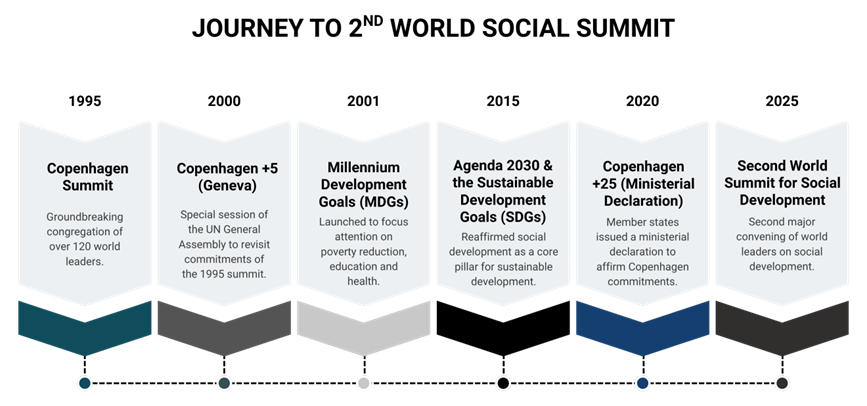
Although, the decades that followed the Copenhagen Summit in 1995 did not see the same level of political energy around social development, there were a few important moments.
A Glimpse of the World Before the First Summit
In the years leading up to the First World Summit for Social Development, the world was grappling with complex and region-specific challenges that made the need for a renewed focus on social development urgent. For example, across Latin America and the Caribbean, debt crises, hyperinflation and stagnant economies had deepened poverty. Many countries were also emerging from military dictatorships with intense social exclusion (of indigenous peoples, women and the poor).
In Asia and the Pacific, development was uneven. Rapid growth in East and Southeast Asia contrasted with persistent poverty in South Asia, where large informal economies and demographic pressures strained governments. Also, the Middle East and North Africa (MENA) faced a different set of constraints. Many countries struggled under authoritarian rule, with limited political freedoms and weak accountability. Youth unemployment, economic vulnerabilities and gender inequality limited development.
The early–mid 1990s were a moment of transition and turbulence across Africa. Nations were navigating political change and, in many cases, the painful economic restructuring that came with structural adjustment programmes. These programmes often slashed social spending, undermined public services and deepened poverty. Unemployment was high, health and education systems were under strain and debt repayments consumed resources that could have been invested in communities.
Achievements and Setbacks Since Copenhagen
The Copenhagen Summit recognised the reality of these global challenges. As Katja Hujo, a leading social policy expert, describes it during the GETSPA webinar, the summit marked a “social turn” — a push to reinsert social dimensions into global development thinking and give Africa a voice in shaping solutions. It also produced a comprehensive agenda that linked poverty eradication, employment, social integration, gender equality, progressive taxation and environmental stewardship. Significantly, it pledged special attention to Africa, Least Developed Countries and economies in transition.
Over the past three decades, there have been meaningful gains. In Africa, primary school enrolment has expanded, women have entered political and economic leadership in greater numbers with improvement in health outcomes, particularly in child survival and HIV/AIDS treatment. Latin America has seen stronger social protection systems and reductions in extreme poverty while Asia has lifted hundreds of millions out of poverty through rapid growth and investments in education and health. The Middle East and North Africa (MENA) region made strides in literacy and life expectancy and even in North America, reforms reduced extreme deprivation. Together, these gains underscore the summit’s enduring influence in putting social development on the global agenda.
Yet progress has been uneven, and many original promises remain unfulfilled. Inequality has widened, both within Africa and between it and wealthier regions. Debt crises are once again choking public investment while climate change, political instability and conflict threaten to roll back hard-won gains. In Latin America, persistent inequality and a resurgence of far-right politics undermine social rights. Asia contends with unequal growth and aging populations while governance deficits, informality and resource constraints plague both Africa and the MENA region. Across all regions, climate change and digital exclusion pose shared challenges.
These setbacks highlight a sobering truth: while the 2025 Summit is global, its credibility will rest on whether it addresses the structural realities shaping social development—especially in Africa, where the stakes are greatest.
Why the 2nd Summit Matters Now
As Katja observes, the current international climate carries “a considerable fear that we might fall back behind past achievements.” The COVID-19 pandemic erased years of social development gains and austerity measures now threaten to shrink already limited social budgets.
The 2025 summit is not just a commemoration. For Africa and some regions, it is a critical moment to push for a new social contract that:
- Tackles structural barriers to equality and opportunity.
- Links economic growth with social investment.
- Protects public services from harmful privatisation.
- Confronts new threats, from digital inequality to climate-driven migration.
If not for anything, there must be resolutions to protect existing achievements. African voices, from governments to civil society, will need to be loud and united to ensure the final declaration responds to the continent’s realities.
GETSPA is committed to amplifying African perspectives and tracking the commitments made. We invite you to follow the journey, join the conversation and help push for transformation. Imagine what we could achieve now, if we care enough to demand it.
References
- United Nations. Conferences | Social Development: World Summit for Social Development, Copenhagen 1995. Available at: https://www.un.org/en/conferences/social-development/copenhagen1995
- United Nations. (1995). Copenhagen Declaration and Programme of Action: World Summit for Social Development. Copenhagen, Denmark, 6–12 March 1995. Available at: https://www.un.org/development/desa/dspd/world-summit-for-social-development-1995.html
- United Nations Department of Economic and Social Affairs (UNDESA). (2020). World Summit for Social Development — Background. Available at: https://www.un.org/development/desa/dspd/world-summit-for-social-development.html
- United Nations, On the road to the Second World Summit for Social Development: contributions from the regional commissions (LC/TS.2024/147), Santiago, Economic Commission for Latin America and the Caribbean (ECLAC), 2025.
- Hujo, K. (2025). Remarks during GETSPA Webinar Advancing Transformative Social Policy in Africa — Towards an Agenda for the Second World Summit for Social Development, 31 July 2025.
- Log in to post comments