
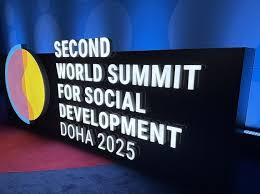
The Solutions Approach of WSSD II: A Missed Opportunity to Promote Transformational Approaches to Social Development?
Dzodzi Tsikata[1]
The organisers of the recently concluded Second World Summit on Social Development in Doha decided to focus on solutions to social development, not the problems. This approach to development is fast becoming a template for a range of actors. For example, a 2018 book by the Brookings Institution edited by Raj M. Desai, Hiroshi Kato, Homi Kharas, and John W. McArthur, with the title “from Summits to Solutions: Innovations in Implementing the Sustainable Development Goals” showcased new approaches to capturing value, targeting places, and updating governance as key for the achievement of the SDGs.

More recently, a series of Climate Solutions Dialogues were convened during the 2025 UN General Assembly to identify concrete solutions for accelerating the implementation of the Paris Agreement. The Dialogues apparently showed that the resources, technologies, and tools to reduce emissions, protect forests, and strengthen resilience, already existed. What was missing was the speed and scale of delivery, and the integration of fragmented solutions and actors.
The WSSD II Summit took this emerging trend to a new level. It created a marketplace of ideas that resembled the beautiful souks of Doha- well organised, friendly, and contained, with no disorder and contestation in sight. This produced a Summit in which the causes of the existential crises facing the planet and humanity such as the ruinous search for profits and the deleterious effects of over fifty years of neoliberalism and extractivism were not up for debate. Instead, a toolkit approach to development was championed despite its questionable efficacy, as evidenced by the lamentations in the Doha Declaration and in plenary speeches about the lack of progress on many of the metrics of social development.
From plenary meetings to high-level roundtables to parallel events, from the civil society forum to the private sector forum, speaker after speaker with very few exceptions focused on highlighting successful solutions and innovations to social development challenges. There were also designated “solutions sessions” organised by member states, UN agencies, civil society, academics, and the private sector. There were solutions square exhibitions where accredited organisations and innovators displayed successful initiatives and good practices that addressed key policy challenges, and there was the solutions studio, a space for public conversations about the commitments to social development.
The Doha Solutions Forum for Social Development, which ran all day on 3rd November was based on the Doha Solutions Platform for Social Development, a dedicated online repository of commitments and initiatives aimed at advancing social development. Launched by the UN in collaboration with Qatar and France before the Summit, it collected 150 solutions to social development. These were structured under four areas—innovative social protection systems; education and workforce development for a future ready world; public-private partnerships for social development; and strengthening social dialogue and participatory governance— described misleadingly, as “broad policy areas that promote integrated policy approaches to social development”-.
Throughout the Summit, governments, businesses, multi-lateral agencies and CSOs queued up to tout their achievements, showcasing two hundred and fifty successful innovations, according to the UN’s report on the Summit. These ranged from micro projects, to policies, laws, and institutional reforms. The five minutes provided for each speaker meant that there was little reflection on the conditions that made success possible, and on the challenges and lessons learned. There was even less time to ask questions, and no time at all for answers, reflections, and dialogue among the different constituencies on questions such as what problem they were trying to solve and how they were measuring success and impact, and how replicable, upgradable, or sustainable these solutions were. More generally, there was scant space to analyse the whys of the wicked problems of social development, what it would take to effect the solutions being offered, what had not worked, and lessons learned from the many initiatives being highlighted.
While there should be a place for discussing and learning from successes in social development, and some of the solutions presented were certainly interesting, this modus operandi of the entire Summit encouraged self congratulation and defensiveness in equal measure. Those with power - governments, business, UN agencies - were the main beneficiaries of the solutions format in that they had their say. Those whose responsibility it was to demand accountability for the thirty years between WSSD 1 and 2, did not have the space to be heard.
Secondly, many of the showcased solutions did not speak to the integrated approach to social policy championed in paragraph 24 of the Doha Political Declaration: “We will explore bold and effective social policies that are woven into a whole-of-government, whole-of-society, people centred and integrated approaches aimed at achieving social development for all”. Although endorsed in several speeches, the integrated approach was undermined by the focus on solutions which presented decontextualised one-size-fits-all approaches as the answer to all the ills of social development. This was a missed opportunity for seriously debating alternatives to currently dominant approaches to social development.
This heavily curated approach had the official and non-official events taking place in the same space, but in parallel worlds. This was vastly different from the great contestations around the big UN conferences of the 1990s, where negotiations on documents would continue until the very last day, with endless rumours about who was resisting which provisions; and strategizing among CSOs about how to reach and influence country delegates. This time, the Doha Declaration, a mixed bag of good language, silences, and controversial recommendations, was adopted in the first hour of the conference, with a worrisome caveat that it would have no implications for the UN budget in 2026.
Its equivocations, limitations, and silences notwithstanding, the Declaration represents a renewed mandate for prioritising social development. While the terrain of work has become a lot more complicated with the coronation of capital as an indispensable agent of social development, the Declaration’s acknowledgement of past failures and unfinished business, and its call for action empowers students and advocates of transformative approaches to social policy to hold states accountable for an alternative agenda for social development that is rooted in life-making and social reproduction. This mandate is a call to challenge facile claims in the Declaration such as the indispensability of public-private partnerships and the need for the formalisation of informal economies. It also provides the space to affirm the state’s developmental role and its primary responsibility for providing public goods, recognise the critical role of the social sciences and humanities and the necessity to reorient social policy away from its current narrow focus on social protection to a broader remit of social transformation. Only then can the post-Doha agenda realise the Declaration’s goal of building just and equitable societies.
[1] Dzodzi Tsikata is a Distinguished Research Professor of Development Studies at SOAS, University of London, the PI of the Gender Equitable and Transformative Social Project for Africa (GETSPA) research project and network, a member of the Steering Committee of the Network For Women’s Rights in Africa (NETRIGHT) and a member of the IDEAS Network.
- Log in to post comments