
The Silence on Macroeconomics: A Critical Miss for WSSD II
Mayada Hassanain
The Second World Summit on Social Development, held in Doha from 4 to 6 November, was significant, marking thirty years since the first summit in Copenhagen. Yet its importance was undercut by a key omission: the discussions paid little attention to the macroeconomic frameworks that continue to constrain social development. Conservative macro policies central to understanding why social progress stalls were largely left unexamined. While the Copenhagen Declaration had carried a sense of optimism, and the Doha Political Declaration sought to renew those commitments, the absence of serious engagement with macroeconomic issues limited the summit’s potential impact despite the high-level participation it attracted.

The Missing Macroeconomic Foundations of Social Development
The scope of discussions was wide-ranging, covering the rights of persons with disabilities, protections for migrant workers in Gulf Cooperation Council states, and the impact of sanctions on national economies. Yet, in sessions focused on social protection and social policy, there was little substantive engagement with the macroeconomic frameworks that ultimately determine governments’ priorities and the policy space available for social investment. Instead, emphasis fell on targeted programming by business, civil society, and governments to support vulnerable groups, with almost no attention to the structural economic constraints that limit states’ ability to finance social policy, most notably the heavy debt burdens facing countries in the Global South. As UNCTAD[1] notes, 3.4 billion people live in countries that spend more on interest payments than on health or education, a reality that went largely unaddressed in the Summit’s discussions.

Several sessions appeared intended to address the economic dimensions of social policy, but presentations largely showcased private-sector initiatives or individual country programmes. However, not all contributions fit this pattern. In one example, a multinational corporate representative argued that companies care about workers’ rights but require governments to implement stronger living-wage regulations before wages can rise. This example illustrates how corporate actors shift responsibility back to governments, which obscures the persistent policy pressures those governments face, for instance, from the World Bank[2], which continues to recommend labour-market deregulation as a strategy for improving labour market outcomes. Additionally, consistent underfunding of public institutions weakens the state’s ability to have better oversight of multinationals to ensure compliance with tax obligations[3].
This omission reflects a broader trend over the past four decades, in which the neoliberal paradigm has narrowed understandings of the relationship between macroeconomic and social policy in three key ways. First, better social outcomes are presumed to flow automatically from the “right” macroeconomic framework, understood to mean low budget deficits, low inflation, minimal price controls and market-oriented reform. The relationship between these macroeconomic priorities, social policy and outcomes is rarely addressed. That is underplayed, despite it now being clear that economic growth alone does not guarantee inclusive social development and can in some cases worsen inequality, increase unemployment, and raise poverty levels.
Second, the counter-cyclical role of social policy during periods of crisis continues to be undermined. IMF policy advice[4] remains predominantly procyclical, prioritizing fiscal consolidation. Because debt crises trigger sustained fiscal contraction, the conditions under which governments, particularly in the Global South, might expand social spending effectively never materialize. Governments are repeatedly told to wait for a more favourable fiscal moment, but that moment never comes.
Third, major components of social policy that extend beyond targeted safety nets, such as progressive labour protection and public employment guarantees remain excluded from consideration because they are not recognised as macroeconomic issues within prevailing policy frameworks. Yet labour is a core real resource of the state, and its conditions wages, rights, job security, and opportunities for upskilling directly shape productivity, aggregate demand, and long-term growth. Poorly implemented (or regressive) labour protections, as is the case in many countries, therefore weaken the economic foundations required for effective social policy. However, at the Summit they were discussed primarily in legal terms, rather than as structural determinants. Treating labour rights as peripheral to macroeconomic policy obscures their central role in creating the conditions under which social development can occur.
Market-led Social Development
This narrowing of policy reflects a shift in how social development has been reframed as residual, increasingly reliant on financialization, public–private partnerships, and private sector-led delivery, and in so doing positioning corporations as central actors in social provision. Throughout the summit, business leadership, corporate responsibility, and private sector “commitments” to workers were repeatedly prioritized, while social registries and targeted assistance remained the dominant model for social policy.
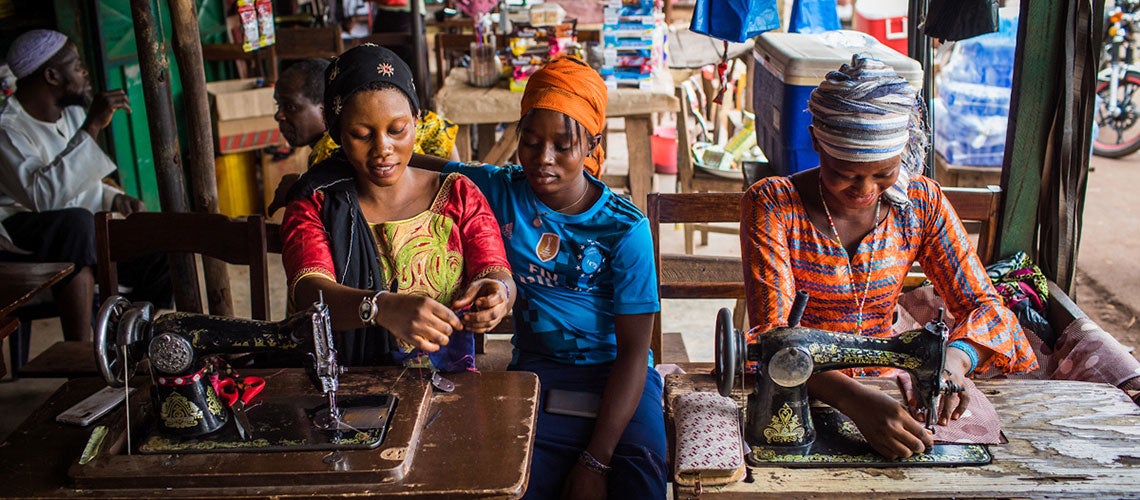
Young women work at sewing clothes in the market. Photo credit: Vincent Tremeau /World Bank
The summit’s agenda itself revealed a strong tilt toward market-oriented approaches. This was most visible in the dedicated Private Sector Forum -a full-day event that framed business as a central actor in social development. Sessions such as “Business as a Driver of Inclusive Social Development,” “Scaling Inclusive Business Solutions for Social Impact,” and “Inclusive and Sustainable Finance for Social Development” placed the private sector at the centre of strategies for employment, skills development, innovation and social protection.
In contrast, non-market forms of value creation and social cohesion, solidarity, unpaid care, and community relations received little meaningful attention, despite their well-established contributions to well-being and productivity. This gap was evident in the session on “Care as core economic infrastructure” organized by UNDP, where the discussion focused largely on convincing policymakers of the “untapped resource” represented by the care economy. Rather than recognising care, solidarity and social reproduction as foundational social goods with intrinsic value, the discussion recast them through a narrow market lens, as potential sources of labour-force expansion or absorption, fiscal returns and productivity gains. Even when non-market contributions appeared on the agenda, they were absorbed back into the same economic logic that routinely sidelines them.
Integrated Social and Macroeconomic Policy
A narrow fiscal framework which prefers low deficits, reduced public spending, and tight monetary targets restricts the state’s ability to invest in the productive capacities that ultimately sustain social policy. As a result, states are often unable to use industrial policy, development-oriented credit, or public investment to diversify their economies and raise productivity. Without these tools, they cannot secure the stable employment, rising wages, and reliable revenues that long-term social protection requires. Macroeconomic policy is therefore inseparable from social policy: it shapes the economic structures on which social programmes ultimately depend.
The summit missed an opportunity to explore how macroeconomic and social policy could be made coherent, including how fiscal expansion can generate employment or how industrial policy which requires government planning also shapes long-term labour outcomes. Such discussions could also have opened space for examining larger structural constraints on social development, including unequal terms of participation in the global economy and the international financial architecture that concretely limit policy autonomy in the Global South and are the main obstacles to progressive social policies.
[1] https://unctad.org/publication/world-of-debt
[2] https://www.worldbank.org/en/publication/wdr2019
[3] https://www.uneca.org/sites/default/files/chapterimages/era2019_eng_Chapter_6.pdf
[4] https://oxfamilibrary.openrepository.com/bitstream/handle/10546/621210/bp-covid-loans-imf-austerity-110821-en.pdf;jsessionid=1364C122CDF7A575CB16BC98D1C23168?sequence=1
- Log in to post comments